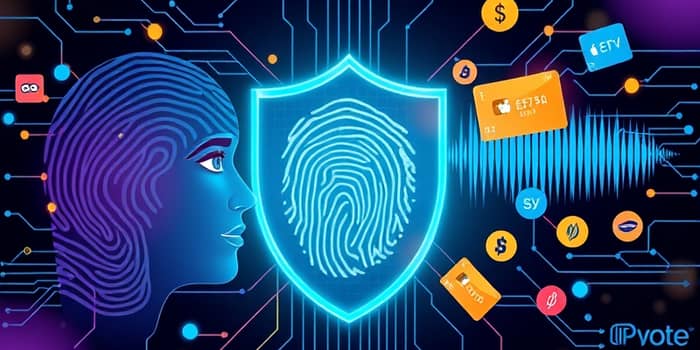
In today’s fast-paced digital landscape, securing online payments and sensitive data has become a critical priority. As malicious actors evolve their tactics, organizations and consumers alike seek robust solutions that offer both convenience and protection. Biometric security systems are emerging as a powerful answer, leveraging innate human traits to validate identity and guard transactions against fraud.
This article explores the transformative rise of biometric authentication, examines current market dynamics, highlights cutting-edge technologies, and addresses the ethical and privacy challenges that accompany this innovation. By understanding both the promise and pitfalls, readers will gain practical insights to champion secure, user-friendly digital experiences.
Biometric payments are rapidly shifting from novelty to norm. The global biometric payments market is projected to surge from $46.38 billion in 2025 to $66.74 billion by 2029, reflecting a robust 9.4% compound annual growth rate. Beyond payments alone, the entire biometric system market is estimated to reach $68.6 billion by 2025, driven by enterprise and consumer demand.
Consumer confidence in biometrics is at an all-time high. In 2025, 83% of users worldwide perceive biometric transactions as safer than traditional PINs or passwords. Mobile devices enabled for fingerprint or facial scans account for 81% of smartphones, while digital wallets with biometric capabilities represent 72% of mobile transactions.
Regional adoption varies but skews toward innovation hubs. The Asia-Pacific region leads with around 60% adoption in 2025 and an impressive 24% annual growth rate. North America and Europe together represent over 53% of the global market, with the UK and Germany driving a 45% increase in biometric payment usage. Among demographics, 64% of Gen Z in the U.S. embrace biometric authentication, while Millennials reach 57% adoption.
At the heart of biometric security lie diverse modalities, each harnessing a unique aspect of human physiology or behavior:
Recent innovations propel these modalities forward. Cloud-based biometric platforms, now adopted by 40% of enterprises, reduce processing latency by 20%. AI-driven fraud detection algorithms enhance real-time anomaly identification, while encryption-based storage safeguards 68% of financial institutions’ biometric templates.
Biometric authentication delivers a rare combination of highly secure identity verification and streamlined user interfaces. Unlike passwords or tokens, fingerprints or facial geometry cannot be forgotten or misplaced, minimizing support calls and eliminating credential reuse risks.
Key advantages include:
Despite its promise, biometric security is not without complexities. Biometric data breaches can be particularly damaging, as stolen fingerprints or iris patterns are permanent. In 2025, attacks targeting biometric databases rose by approximately 31%, and 43% of consumers express distrust about sharing their personal identifiers.
Implementation costs also pose hurdles. Roughly 28% of small businesses cite upfront expenses for specialized hardware and software as a significant barrier. False rejection rates hover around 5% of transactions, influenced by lighting conditions, physiological changes, or sensor quality. Additionally, legacy infrastructure often lacks built-in biometric modules, necessitating expensive retrofits.
Regulatory and ethical issues further complicate deployment. Compliance with frameworks like GDPR in Europe demands stringent data handling policies. Algorithmic bias in facial recognition can lead to exclusion or misidentification, raising concerns about fairness and equal access. Surveys reveal that 25% of users are unclear on how biometric payments function, underscoring the need for transparency.
Financial institutions are at the vanguard of biometric adoption. In the U.S., 70% of banks plan to integrate fingerprint and facial recognition for mobile banking by 2025. Retailers worldwide deploy voice-activated checkouts and contactless facial scans to enhance the point-of-sale experience.
Cryptocurrency wallets leverage biometric locks to secure private keys, ensuring that only the authorized user can initiate transfers. In travel and hospitality, biometric kiosks expedite airport check-ins and boarding, reducing queues and enhancing passenger satisfaction.
The next frontier in biometric security hinges on convergence and intelligence. Multimodal biometric systems are gaining traction as they deliver unparalleled accuracy by cross-validating two or more traits. AI-enhanced platforms will continuously learn user behavior, reducing false rejections and proactively flagging suspicious activity.
Wearable devices are poised to extend biometric authentication beyond smartphones. Smartwatches and earbuds with embedded sensors could authenticate payments or unlock devices seamlessly, especially among younger demographics showing a 41% surge in wearable adoption.
Moreover, cloud-native biometric services will democratize access for small businesses, lowering entry costs and enabling cross-platform security without extensive on-premises infrastructure. Contactless methods—facial, voice, and behavioral—will dominate in a post-pandemic world that values hygiene and convenience.
As quantum computing and advanced AI emerge, ongoing research is crucial to future-proof encryption schemes and anti-spoofing measures. Collaborative industry consortia can establish open standards to foster interoperability and guard against discriminatory biases.
In conclusion, biometric security stands as the ultimate shield for digital transactions—uniting innovation with practicality. By balancing rigorous privacy safeguards with cutting-edge technologies, stakeholders can build a resilient, frictionless future for global commerce and digital identity. Organizations that embrace this paradigm shift today will set the standard for trust, efficiency, and security tomorrow.
References