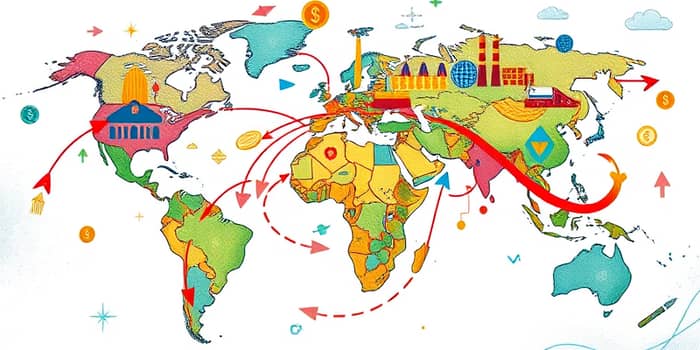
In an increasingly interconnected world, financial transactions crossing national boundaries shape the economic fortunes of nations and create opportunities—and risks—for investors and policymakers alike. Understanding these movements is essential for fostering sustainable growth and stability.
Cross-border capital flows encompass a variety of financial instruments that move across national borders, driven by different time horizons and risk preferences.
These categories capture motivations ranging from stabilizing reserves to pursuing higher yields abroad.
Economists quantify cross-border capital flows by aggregating the sum of FDI, portfolio equity, and debt relative to gross domestic product (GDP), offering insight into a nation’s financial integration.
High-income economies often record gross flows averaging 150% of GDP, reflecting deep financial linkages. Emerging and low-income countries, by contrast, see flows near 25% of GDP, indicating more selective engagement in global markets.
Historical data illustrate dramatic growth: by 2006, global investment flows across portfolios, reserves, and other instruments approached USD 13 trillion—triple the volume from a decade earlier. Foreign exchange markets, including over-the-counter derivatives, averaged USD 5.3 trillion in daily transactions, surpassing USD 60 trillion annually.
Recent snapshots show two-way dynamics: in 2021, the United States channeled USD 213 billion into Europe, while European investors allocated USD 126 billion to U.S. assets. Such reciprocity underscores the complexity of modern capital movements.
This summary table highlights the distinct roles, stability profiles, and impacts of each flow type, equipping stakeholders to make informed strategic decisions.
Capital moves in response to a blend of domestic surpluses and foreign opportunities, shaped by monetary, fiscal, and market forces.
Recognizing these forces allows investors to anticipate inflow surges or withdrawals and design policies that smooth volatility.
While capital inflows can spur growth by closing financing gaps, they also expose economies to cyclical swings. Effective oversight and contingency planning are essential.
Global organizations play a critical role in stabilizing flows and providing liquidity during crises. The International Monetary Fund coordinates emergency financing, while central banks deploy swap lines to ensure access to foreign currency funding when markets tighten.
Within the European Union, the principle of open markets and harmonized regulation enables seamless capital movement among member states, enhancing efficiency and reducing fragmentation.
Policymakers can strengthen resilience by reducing unnecessary capital controls, encouraging market transparency, and pursuing macroprudential policies that temper excessive credit growth without stifling investment.
Since 1998, aggregate cross-border flows have more than doubled globally. In the last decade alone, most regions witnessed a threefold increase in both inflows and outflows, with the lion’s share of expansion occurring in the past five years.
In early 2025, European investors withdrew €13 billion from U.S.-focused equity funds, redirecting €125 billion to Europe and international funds. Such allocation shifts underscore the agility of modern capital in responding to relative performance and perceived risk.
Swap arrangements between the U.S. Federal Reserve and other central banks during recent stress episodes highlight the speed at which authorities must act to maintain global liquidity and confidence.
Investors seeking to navigate cross-border markets should diversify across regions and asset classes while monitoring macroeconomic variables—interest rates, inflation, government spending—to anticipate sudden reversal of capital flows. Corporations aiming to attract FDI can bolster governance, streamline regulations, and offer stable incentives over the long term.
Emerging economies prone to episodic volatility may employ macroprudential tools, accumulate adequate foreign exchange reserves, and develop robust local capital markets to absorb shocks. Timely multilateral support, including IMF facilities and swap lines, can alleviate acute funding pressures during downturns.
Cross-border capital flows remain a cornerstone of modern finance, enabling the efficient allocation of resources across borders. By comprehending the various instruments, deciphering push and pull factors, and adopting prudent risk-management practices, investors and policymakers can leverage these flows for sustainable growth. A balanced approach—combining openness, sound regulation, and international cooperation—will ensure that capital movements continue to fuel innovation, productivity, and global prosperity.
References