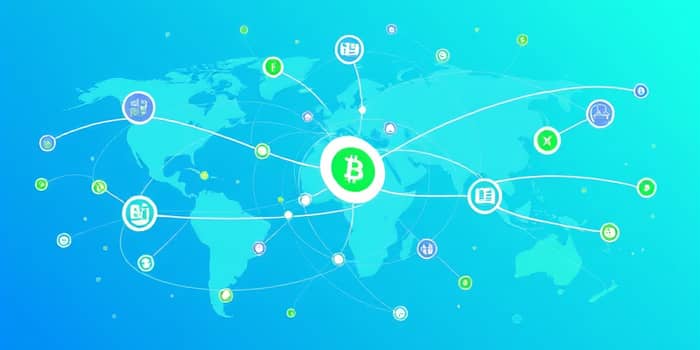
In recent years, a seismic shift has taken place in the world of finance. Decentralized Finance, or DeFi, harnesses blockchain technology to create a new, borderless financial ecosystem. This article delves into its core principles, rapid growth, inherent opportunities, and emerging challenges.
At its heart, DeFi delivers financial instruments without intermediaries. These services run on open networks powered by smart contracts, primarily on Ethereum. Users interact directly peer-to-peer, removing traditional gatekeepers like banks or brokers.
The fundamental principles of DeFi include:
The momentum behind DeFi is undeniable. By mid-2025, Total Value Locked (TVL) in DeFi protocols soared to $123.6 billion, marking a 41% year-on-year increase. The DeFi token market cap reached $98.4 billion in June 2025, illustrating substantial investor confidence.
Forecasts predict the global DeFi market expanding from roughly $31 billion in 2025 to between $592.8 billion and $2 trillion by 2032–2035. Such explosive growth is fueled by a CAGR of over 50%, as institutions, retail users, and innovators flock to decentralized applications (dApps).
User adoption statistics further underscore DeFi’s reach:
DeFi encompasses a diverse array of financial services, each addressing different needs:
Institutional participation has also climbed, with $9.3 billion in whitelisted lending pools, reflecting 60% YoY growth. This trend indicates that traditional financial entities are recognizing the potential of on-chain finance.
Ethereum remains the dominant network, hosting 63% of DeFi TVL ($78.1 billion). However, Layer-2 scaling solutions and alternative chains have gained traction:
Innovations are also transforming the space. AI-integrated risk management platforms, DePIN tokens, and restaking services like EigenLayer ($6.3 billion deposits) point to a rapidly evolving technology stack.
Comparing traditional finance (CeFi) with DeFi highlights key distinctions in control, transparency, and accessibility:
This clear comparison underscores DeFi’s potential to democratize financial services and foster innovation at unprecedented scales.
DeFi offers numerous benefits over traditional systems. Users can earn higher yields on savings and lending, often surpassing centralized rates. Transactions settle in near real-time, enabling instant, borderless asset transfers.
Global inclusivity is another hallmark: in regions like Latin America, DeFi provides vital financial services and currency stability. The modular design of protocols—dubbed “Money Legos”—encourages cross-product innovation, giving rise to synthetic assets, decentralized insurance, and DAO governance.
Despite its promise, DeFi is not without pitfalls. Smart contract vulnerabilities can lead to significant losses; hacks remain common. Many lending platforms require overcollateralization, limiting borrowing flexibility for users without substantial assets.
On-chain transactions are irreversible, and lost private keys mean irrevocable asset loss. Regulatory ambiguity around KYC and AML compliance further complicates mass adoption. Additionally, complex interfaces and prevalence of scams pose barriers for less technical users.
Regulators and institutions are gradually engaging with DeFi. North America leads with 37% market share and robust innovation communities. Europe follows with 29%, advancing clear guidelines, while Asia Pacific holds 23%, driven by fintech hubs.
Traditional financial players are exploring compliance-friendly DeFi solutions, including whitelisted lending pools and tokenized bonds. As regulatory frameworks solidify, institutional onboarding is expected to accelerate.
The outlook for DeFi remains bullish. Market projections estimate growth from approximately $30 billion in 2024 to up to $592.8 billion by 2032. Cross-chain activity is expanding rapidly, with 52% YoY growth in interoperability solutions.
Emerging trends include deeper AI integration for automated risk management, enhanced data analytics, and simplified mobile interfaces. The proliferation of new application categories—such as decentralized insurance and governance platforms—will further diversify the ecosystem. As younger, mobile-first demographics like Gen Z continue to adopt DeFi, the movement toward a truly borderless financial system appears inevitable.
Decentralized Finance stands at the cusp of transforming how we manage, move, and interact with money. By embracing innovation, addressing risks, and fostering inclusive growth, DeFi may indeed represent the next paradigm in global finance.
References