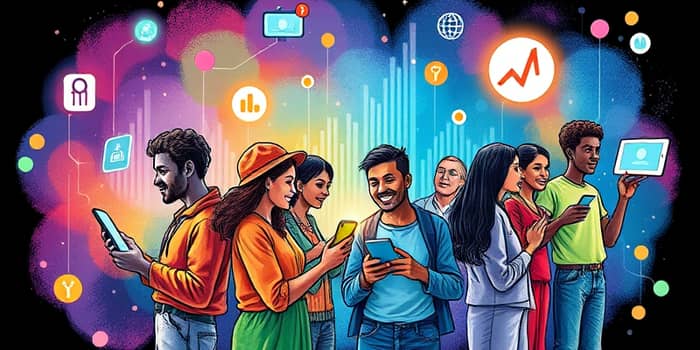
The advent of digital lending has ushered in a new era in finance, breaking down barriers and expanding opportunity for individuals and businesses across the globe. By harnessing the power of technology, traditional credit models are evolving into inclusive ecosystems, offering tailored solutions at unprecedented speed. This revolution is not only reshaping how money moves, but also how dreams take flight, from small business ventures to personal milestones.
At the heart of this transformation lies a vision of financial democratization. In a world where millions remain underserved by conventional banks, mobile-driven financial inclusion worldwide is becoming a reality. As we explore the landscape of digital lending, we will dive into market trends, examine challenges, and envision a future where credit is truly accessible to all.
Digital lending refers to the provision of loans through online or digital platforms, bypassing traditional brick-and-mortar branches. These platforms include fintech startups, neobanks, non-banking financial companies (NBFCs), and digital subsidiaries of established banks. From application and underwriting to disbursal and repayment, the entire process is fully digitized, leveraging AI, machine learning, and alternative data sources to assess creditworthiness.
Borrowers interact with intuitive interfaces on their smartphones or computers, eliminating paperwork and streamlining every step. For lenders, automation and data analytics enable scalable operations, offering minimal documentation and faster approvals to a broad range of customers, including those traditionally overlooked by legacy systems.
The digital lending market has witnessed remarkable expansion. Valued at USD 8.89 billion in 2024, it is projected to reach USD 37.56 billion by 2034, reflecting a robust compound annual growth rate (CAGR) of 15.5%[1]. Other industry estimates paint an even grander picture: forecasts of USD 507.27 billion by 2025 and USD 889.99 billion by 2030 underscore the immense potential of fintech-driven credit[5][7].
Regional dynamics reveal stark contrasts and opportunities:
A direct comparison highlights the disruptive advantages of digital lending:
Several forces propel the growth of digital lending, each unlocking new possibilities:
The benefits extend across stakeholders. Lenders enjoy low operational costs and faster scale, while borrowers gain access to funds with clear fees and transparent terms. Automated risk models can tailor rates to individual profiles, potentially rewarding low-risk customers with better offers.
Despite its promise, digital lending must navigate complex hurdles. Regulatory frameworks vary widely, requiring platforms to adapt swiftly to changing compliance standards. Inadequate oversight can lead to consumer protection concerns or market instability. Meanwhile, cybersecurity threats loom large, making robust encryption and data governance essential.
Additionally, the reliance on unconventional data sources demands rigorous validation. While alternative data can enhance inclusion, it can also introduce biases or inaccuracies. Managing credit risk without traditional collateral further raises the stakes for lenders seeking sustainable growth.
The horizon of digital lending is defined by innovation:
These trends promise a future where credit is not only accessible but also aligned with broader social and environmental goals. By embracing innovation while managing risk, digital lenders can unlock new value for communities and investors alike.
From small business financing to peer-to-peer lending, digital platforms cater to diverse needs:
MSME Lending: Platforms like FlexiLoans deliver urgent working capital to micro-entrepreneurs, backing local economies with rapid processing and personalized service.
Consumer Loans: In the United States, digital channels are expected to originate 63% of personal loans by 2025, streamlining everything from debt consolidation to home improvement financing[9].
P2P Lending: Peer-to-peer marketplaces connect individual investors with borrowers, offering novel risk-reward profiles and bypassing traditional banking intermediaries[10][12].
Digital lending is powered by a mix of agile fintech startups, nimble neobanks, and institutional giants. Notable players include LendingClub, FlexiLoans, and a growing array of digital arms launched by established banks. Collaborative ecosystems, enabled by open APIs and embedded finance, are fostering partnerships that extend credit to consumers at checkout or through everyday business software.
These collaborations emphasize user experience, with intuitive apps, round-the-clock support, and transparent dashboards. By prioritizing consumer-centric design and real-time analytics, market leaders are setting new standards for speed, reliability, and trust.
Digital lending is more than a technological advancement; it represents a paradigm shift in how capital flows. By democratizing access, reducing friction, and harnessing data-driven insights, it empowers individuals and enterprises to pursue growth, innovation, and stability.
As the market expands and matures, stakeholders must balance opportunity with responsibility. Robust regulation, ethical data practices, and a commitment to inclusion will be pivotal. Through collaboration and continuous innovation, digital lending can fulfill its promise of universal credit access, fueling economic progress and uplifting communities around the world.
Embracing this evolution means subscribing to a vision where financial services are not gatekept but shared. The journey continues, and every new loan disbursed online brings us one step closer to a more inclusive, resilient global economy.
References