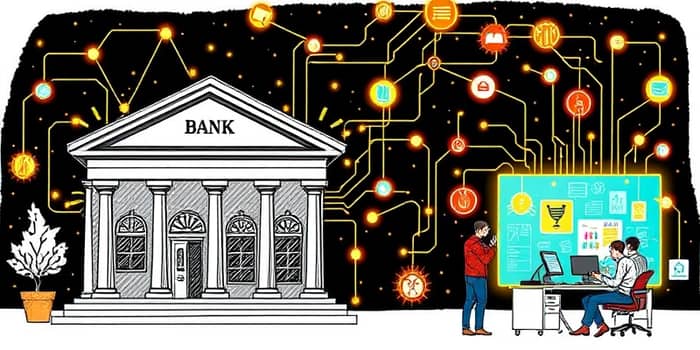
In an era where the financial landscape is rapidly evolving, digital transformation in financial services has become a strategic imperative. Banks and fintechs are finding that collaboration unlocks opportunities for innovation, inclusion, and growth that neither could achieve alone.
Over the past decade, partnerships between established financial institutions and agile fintech startups have shifted from isolated pilot programs to a mainstream business strategy. Industry data shows 84% of fintech firms collaborate with incumbent banks, a testament to the power of integrated ecosystems over direct competition.
According to leading analysts, the global fintech market size projected at $394.88 billion in 2025 is set for a sustained compound annual growth rate (CAGR) of 16.2%, reaching over $1.1 trillion by 2032. In the first half of 2025, global fintech funding totaled $44.7 billion across 2,216 deals, reflecting investor selectivity but continuous inflows into high-potential solutions.
In addition to funding, fintech revenue growth stands at 21% year-over-year, more than triple the traditional financial sector’s 6% pace. EBITDA margins across partnered fintechs have strengthened as scale economies kick in, enabling reinvestments in product development, talent acquisition, and advanced risk management tools.
Both banks and fintech companies enter partnerships with distinct yet complementary goals:
For banks, these collaborations enable faster market entry by leveraging fintech agility without the need to overhaul legacy systems. Fintechs benefit from bank licenses, compliance frameworks, and large customer bases, significantly lowering barriers to scale and enhancing regulatory support.
The foundation of modern fintech partnerships lies in modular integration frameworks. Leading models include API-driven connections, technology provider agreements, and co-branded offerings. Data sharing arrangements, agent banking, and joint ventures round out the partnership spectrum, each tailored to strategic objectives and risk appetites.
Another rapidly growing model is Banking-as-a-Service sponsor bank frameworks, which empower fintechs to launch fully regulated products under a banking license. This approach is particularly transformative in underserved markets, where infrastructure gaps demand nimble, embedded finance solutions.
Fintech partnerships deliver measurable benefits across cost structures, revenue streams, and customer engagement:
Leading banks report EBITDA margin improvements as high as 300 basis points after deploying automated lending and compliance platforms. Collaborations also extend credit to previously overlooked customers, reducing default rates through enhanced data analytics and collaborative underwriting models.
Partners are deploying AI-powered chatbots, robotic process automation, and predictive analytics, further democratizing access and reducing time-to-market for complex financial products.
Since 2022, regulatory bodies such as the FDIC, CFPB, and OCC have intensified scrutiny over fintech partnerships. Early engagement with regulators is now a best practice, ensuring that products comply with emerging guidelines on risk management and consumer protection.
In 2025, the OCC emphasized the necessity of robust risk management and due diligence frameworks prior to launch. While this has raised compliance costs, it also fosters sustainability by mitigating reputational and financial risks associated with third-party relationships.
High-profile enforcement actions against failures such as Synapse and Evolve have underscored the importance of continuous due diligence, strengthening industry-wide governance standards.
Despite clear benefits, partnerships come with operational hurdles. Aligning compliance standards across organizations requires continuous monitoring, standardized controls, and transparent communication channels.
To tackle these challenges, firms are investing heavily in scalable compliance tools, AI-based monitoring, and joint governance models. In particular, prioritizing automated compliance and regulatory reporting can streamline audits and reduce error rates, preserving trust and agility.
Emerging economies often lead in fintech innovation due to fewer legacy constraints and pressing needs for financial inclusion. In regions like Latin America, Africa, and Southeast Asia, partnerships have catalyzed mobile wallet adoption and micro-lending programs targeting underbanked communities.
Non-partnering fintechs remain a small minority—16% globally—but this figure rises to 29% in Latin America and 21% in Europe, highlighting opportunities to deepen collaboration. Lessons learned in high-growth markets are now informing strategies in more mature ecosystems seeking to close inclusion gaps.
As the industry matures, the initial sprint toward rapid growth will give way to a focus on resilience, compliance, and customer-centric refinements. Future drivers include enhanced data interoperability, real-time payments, and open banking and ecosystem-based digital services.
Partnerships that balance innovation ambition with disciplined risk governance will lead the next wave of digital financial services. By investing in shared platforms, continuous regulatory dialogue, and scalable infrastructures, banks and fintechs can co-create value that reshapes the global financial landscape and furthers financial inclusion worldwide.
References