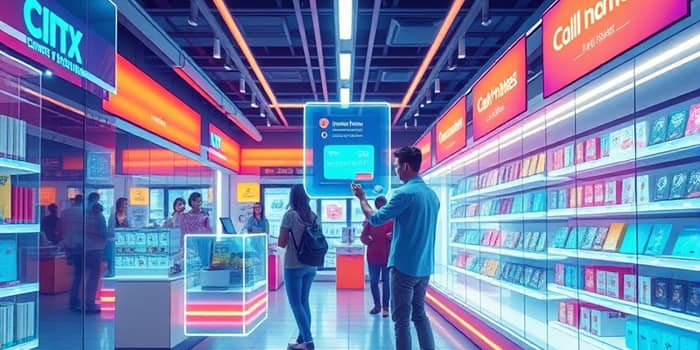
Imagine a world where paying for goods feels like stepping into science fiction—where floating interfaces and three-dimensional displays make transactions intuitive, secure, and almost magical. This is the promise of holographic payments, a revolution poised to redefine how we exchange value.
At its core, holography records and reconstructs light waves to produce fully three-dimensional images. A laser beam splits into a reference beam and an object beam. The object beam reflects off a subject, and the interference pattern between both beams is stored on a recording medium. When illuminated by the reference beam, the pattern reconstructs the original light waves, creating a lifelike 3D image.
Advancements in dynamic holography now enable real-time recording and reconstruction, driving applications in optical computing and image processing. This continuous evolution sets the stage for holographic payment terminals that respond instantly to user input.
Japan’s 7-Eleven stores have become early adopters of holographic point-of-sale systems. Developed by Toshiba, the Digi POS projects a floating touchscreen that accepts only cashless methods—credit cards, e-money, or QR codes. Using Neonode’s touch-sensor modules, customers simply wave their hand to select and confirm, with no physical contact required.
Such trials demonstrate that holographic systems can be more than a novelty—they can become everyday tools that streamline retail operations and boost consumer confidence.
Security is at the heart of payment innovation. Holographic credit cards incorporate matched optical filters to embed unique identification data and biometrics, such as fingerprints or iris patterns. Only the correct biometric match reveals the payment credentials. This method is resistant to mechanical damage and counterfeiting, thanks to advanced holographic masks and frequency-domain filters used for image recognition.
On the currency side, many banknotes already leverage holographic portraits and patterns to thwart forgers. Japan’s newest bills feature multi-layered holograms that shift depth and color when tilted—making them virtually impossible to replicate with conventional printing.
Beyond payments, holography is transforming data storage. By encoding information in three dimensions, a single holographic disk can hold terabytes of data. A reference beam reconstructs stored patterns instantaneously, offering fast read/write times and robust durability for archival use.
Meanwhile, financial institutions are experimenting with holographic AI assistants—virtual, three-dimensional advisors that guide customers through transactions, budgeting, and investment strategies. These assistants harness blockchain integration to deliver transparent, tamper-proof records of every advisory session.
Holography’s appeal extends into entertainment, where artists perform as lifelike 3D projections. In marketing, brands craft immersive store environments that guide shoppers with holographic wayfinding. Educational institutions use holographic displays to bring complex concepts to life, from molecular structures to historical reconstructions.
However, widespread adoption depends on consumer trust and perceived value. Early adopters must see clear benefits in convenience, security, and novelty. Surveys indicate that while 60% of users value hygiene and contactless payments, only 35% are willing to switch without demonstrable advantages.
The future of payments lies in seamlessly blending the physical and digital. Imagine stepping into a café, tapping a button mid-air, and seeing your transaction approved with a holographic confirmation that floats before you. No wires, no screens to wipe, and no lingering doubts about security.
To prepare for this future, businesses can pilot holographic kiosks in high-traffic areas, gather user feedback, and collaborate with technology providers to refine user experiences. Consumers can seek out retailers offering innovative payment options and learn about biometric safeguards to build confidence.
As holographic transactions move from trial to mainstream, they promise to offer a safer, more engaging payment journey—one that feels like stepping into tomorrow, today.
References