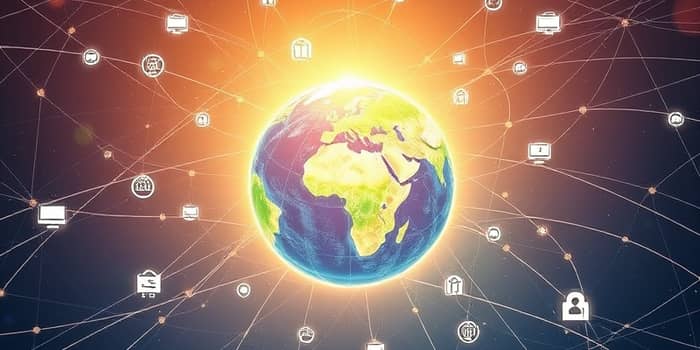
In the closing decades of the 20th century and into the 21st, the world witnessed a transformative wave of integration that far surpassed earlier eras. This era, known as hyper-globalization, saw the rapid acceleration of economic, social, and technological exchange reshape how nations, businesses, and individuals interact. What began as incremental trade and cultural contacts evolved into a blistering pace of interconnectedness that redefined markets, governance, and everyday life.
Hyper-globalization is not merely an intensification of trade; it represents a fundamental shift in the permeability of borders. From the early 1990s through the 2000s, global flows of goods, capital, and ideas surged to unprecedented levels. National policies and business models were rewired to leverage a world in which goods, services, capital, people, and ideas flow with minimal friction.
This era altered the core functions of states and corporations. Governments tailored regulations to attract foreign direct investment, while multinationals orchestrated production networks spanning dozens of countries. Consumers benefited from diversity and choice, while workers faced new competitive pressures. In essence, hyper-globalization reframed the rules of the economic game.
Three interlinked forces propelled hyper-globalization:
Together, these forces created a profoundly new environment in which traditional barriers weakened and the global marketplace achieved unprecedented scale and speed.
To appreciate the scale of hyper-globalization, consider these landmark figures:
These trends highlight how investment, communication, and supply chains became deeply interwoven across continents.
The neoliberal paradigm underpinned hyper-globalization. Deregulation efforts, investor–state dispute settlements, and multilateral agreements like NAFTA, the WTO framework, and the TPP reduced barriers and harmonized rules. While these policies spurred growth, they also triggered a race to the bottom on labor and environmental protections in some jurisdictions.
Multinational enterprises capitalized on these frameworks, distributing production stages worldwide. This strategy optimized costs but introduced complexity and vulnerability into supply networks.
These gains underscored the positive potential of integration, fueling optimism about ever-expanding global opportunity.
Populist movements in several countries blamed globalization for erosion of wages and social cohesion, leading to protectionist policies and political fragmentation.
The COVID-19 crisis starkly revealed over-reliance on global supply chains for critical goods like PPE and semiconductors. Concurrently, rising tensions between the U.S. and China prompted export controls and calls for “decoupling.” Energy and food security concerns, amplified by the Russia-Ukraine conflict, further fractured global cooperation.
These events accelerated a trend toward regionalization, with concepts such as nearshoring and friend-shoring gaining traction as nations seek resilience over pure efficiency.
Looking ahead, the era of seamless hyper-globalization is giving way to a more fragmented regime. We can anticipate:
Advanced economies may settle into slower growth trajectories, while digital services and green technologies drive the next phase of global value creation.
China’s accession to the WTO in 2001 epitomized hyper-globalization’s power to reshape manufacturing and trade networks. The subsequent “China shock” cost millions of U.S. manufacturing jobs but lifted hundreds of millions out of poverty in Asia.
More recently, U.S. export restrictions on semiconductor technology and global chip shortages illustrate how strategic industries become focal points in geopolitical competition, prompting reshoring initiatives.
Scholars such as Dani Rodrik argue for a selective or “thin” globalization that prioritizes democratic sovereignty and social welfare over unfettered market access. Others highlight AI’s role—Andrew Ng likens its impact to that of electricity—in driving future waves of connectivity and disruption.
Policymakers now face the challenge of balancing openness with resilience, forging rules that safeguard public goods without stifling innovation.
Hyper-globalization transformed the world at warp speed, unlocking economic growth, innovation, and cultural exchange on a massive scale. Yet the same forces exposed vulnerabilities and inequality, fueling backlash and fragmentation.
As we navigate the post-hyper-global era, the imperative is clear: design integration frameworks that harness connectivity while ensuring sustainability, equity, and resilience. In doing so, we can chart a path toward a global order that benefits all stakeholders—nations, communities, and individuals alike.
References