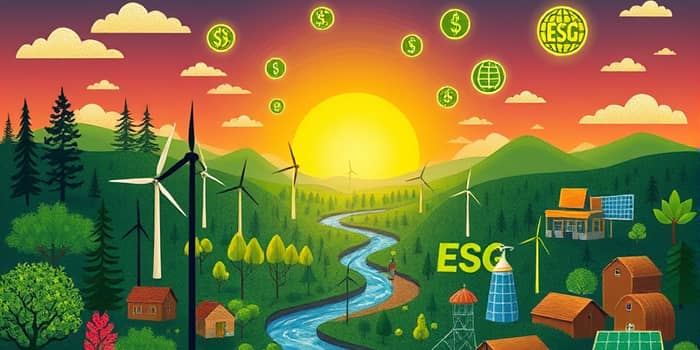
As our planet faces unprecedented climate challenges and social inequalities, the role of finance has never been more critical. Sustainable economic projects and societal goals are no longer niche concerns—they define the future of capitalism itself. By integrating environmental, social, and governance factors into every investment decision, sustainable finance charts a path toward a resilient, inclusive world.
At its core, sustainable finance is the practice of embedding ESG considerations into financial analysis, portfolio construction, and capital allocation. It is shaped by several interrelated concepts:
By harnessing these tools, investors aim to deliver returns that reflect not only financial profit but also long-term planetary health and social well-being.
The sustainable finance market has experienced explosive growth over the past decade. Green bonds, ESG equity funds, and sustainability-linked loans are expanding rapidly, channeling capital toward projects that align with the UN 2030 Agenda and Paris Agreement targets.
According to the World Economic Forum, nature-positive transitions—including regenerative agriculture and sustainable infrastructure—could unlock up to $10 trillion in annual business value and create nearly 400 million jobs by 2030.
These figures underscore the enormous economic opportunity embedded in sustainable development, revealing how finance can be redirected to serve both people and planet.
A diverse toolkit of financial products has emerged to support the sustainable finance revolution. These instruments share a common goal: to mobilize private investment in solutions that address climate, biodiversity, and social challenges.
By blending public and private capital, stakeholders can overcome initial risk barriers and scale projects that might otherwise remain unfunded.
Robust policy frameworks are vital to ensuring sustainable finance achieves genuine impact. The European Union has led the way with landmark initiatives:
Beyond Europe, global efforts are converging toward common ESG disclosure standards, including those set by the International Sustainability Standards Board. Together, these regulations aim to create a level playing field and drive accountability.
Despite rapid progress, sustainable finance faces substantial hurdles. A standardization gap persists as definitions of “green” or “sustainable” vary across jurisdictions, complicating cross-border capital flows.
Measuring real-world impact remains a significant challenge. Reliable, consistent ESG data is scarce, and some instruments risk becoming vehicles for greenwashing rather than genuine transformation.
Additionally, the emergence of “in-transition” or “amber” categories highlights the difficulty of financing sectors that are not yet fully sustainable but are on a path to decarbonization.
The future of sustainable finance is bright, driven by innovation, collaboration, and a deepening recognition that long-term value arises from healthy ecosystems and equitable societies.
Key opportunities include:
As private capital continues to flow toward sustainability priorities, the financial sector will play a central role in delivering the UN Sustainable Development Goals and global climate targets.
Sustainable finance represents a powerful lever for change, fusing financial returns with tangible environmental and social impact. By supporting renewable energy, nature-positive transitions, and inclusive economic development, investors can help steer the world toward a greener, fairer tomorrow.
Ultimately, the true measure of success lies not only in balance sheets but in the resilience of our communities and the health of our planet. Embracing sustainable finance today is an investment in a flourishing future for all.
References