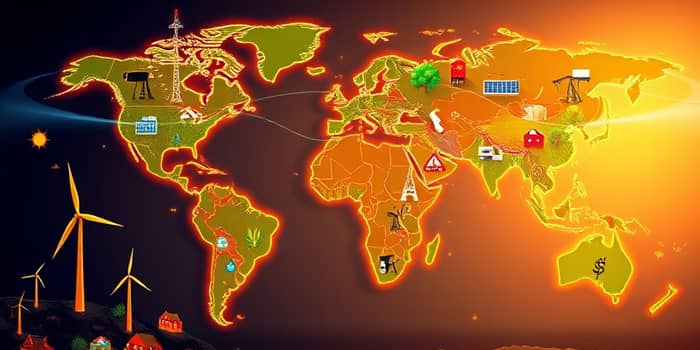
The global shift from fossil fuels to renewable energy is not only an environmental necessity but also a profound financial transformation. From investment flows to cost structures, economic development to policy frameworks, understanding these dynamics is essential for governments, investors, and communities alike.
In 2024, $3 trillion in total energy investment was deployed worldwide. Remarkably, two-thirds allocated to clean energy technologies and infrastructure signaled a robust commitment to decarbonization. During the first half of 2025, renewable energy saw record inflows of $386 billion, a 10% year-on-year uplift.
Nevertheless, fossil fuel projects continue to attract significant capital, especially in regions dependent on oil and gas exports. The juxtaposition of growing clean energy funding with sustained hydrocarbon financing reflects a transitional economy caught between legacy systems and new pathways.
Investment patterns reveal where stakeholders see value and opportunity:
Since 2022, solar module prices have plummeted 35% to 9 cents per watt, and electric vehicle batteries now cost under $100 per kilowatt-hour. These reductions have reshaped the levelized cost of electricity (LCOE), making 81% of new renewable capacity additions in 2023 cheaper than their fossil rivals.
Over two decades, renewables have delivered up to $409 billion in avoided fuel costs since 2000, with Asia saving $212 billion, Europe $88 billion, and South America $53 billion between 2000 and 2010 alone.
While renewable projects involve higher upfront costs but much lower and predictable operational expenses, power purchase agreements (PPAs) further shield buyers from oil and gas price shocks.
Beyond pure finance, the energy transition drives tangible benefits for communities and economies:
Government action remains pivotal. Tax credits, accelerated depreciation schedules, and direct subsidies bridge the gap between emerging renewable technologies and mature fossil systems. In the United States, the Investment Tax Credit has catalyzed solar installations, while similar schemes in Europe and Asia incentivize wind and storage deployment.
Although clean energy support has surged, fossil fuel subsidies still outpace renewables by almost tenfold globally. Institutional investors, sovereign wealth funds, and private equity are now pivotal, accounting for the majority of clean energy capital, a shift from earlier reliance on public financing.
Despite robust investment growth, financing gaps remain. Achieving net-zero emissions by 2050 requires significantly higher capital flows, particularly to emerging economies facing elevated borrowing costs and limited access to affordable financing.
Upgrading grids to accommodate variable renewables demands billions in additional spending for transmission, distribution, and storage. Policy delays, permitting hurdles, and trade tariffs can inflate energy system costs by 2–3% over baseline projections.
The affordability of energy and the structure of electricity bills—grid fees, levies, and taxes—also raise distributional concerns. Low-income households often bear a disproportionate share of system costs, risking social equity and undermining public support unless policies address these imbalances.
Looking ahead, clean energy investment is poised to accelerate, yet fossil fuels remain embedded in certain sectors for security and economic reasons. Emerging business models for battery storage, hydrogen commercialization, and grid services will expand, offering new revenue streams and risk management tools.
The easiest segments—power generation and light transport—are leading decarbonization, while hard-to-abate sectors such as heavy industry and aviation require sustained policy support and technological breakthroughs.
As the energy transition progresses, stakeholders must navigate complex trade-offs between short-term capital expenditures and long-term operational savings, balance regional equity with global imperatives, and harness both public incentives and private capital to bridge existing investment gaps.
Ultimately, the financial implications of moving to a cleaner energy system are far-reaching, shaping economies, societies, and the planet’s future. Stakeholders who understand these dynamics can seize opportunities, manage risks, and drive a more resilient and equitable energy landscape.
References