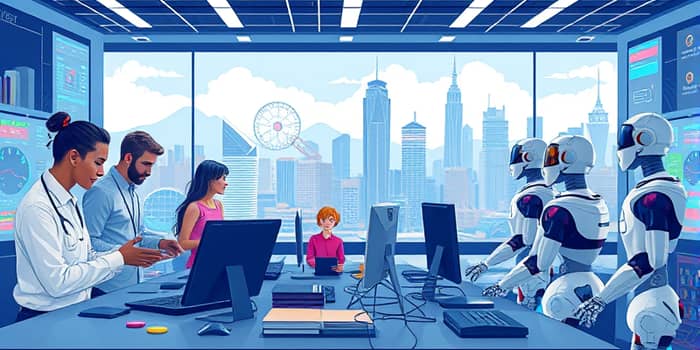
Automation and artificial intelligence are no longer distant concepts—they are reshaping our workplaces and livelihoods today. As machines take on routine tasks, the world faces both challenges and opportunities.
In this article, we explore the latest data, industry impacts, skill transformations, and policy responses needed to thrive in an era of rapid technological change.
Up to 30% of current US jobs could be automated by 2030, and 60% will see significant task changes due to AI. Globally, 300 million jobs—about 9.1% of all roles—are at risk of automation.
But the story is not one of pure job destruction. According to the World Economic Forum, while 92 million roles may be displaced by 2030, 78 million new positions will emerge, highlighting a transformation rather than pure net loss.
Automation’s reach extends across economies and sectors. In advanced economies, up to 60% of jobs face significant change, compared to 26% in lower-income nations. Entry-level workers are especially vulnerable, with almost 50 million US positions at risk in the coming years.
Real-time data shows that from January to June 2025, nearly 78,000 US tech jobs were lost directly due to AI, and since 2000, automation has eliminated 1.7 million US manufacturing roles. Moreover, 13.7% of American workers say they personally lost a job to a robot or AI.
The nature of work determines vulnerability. Routine, repetitive tasks are prime candidates for automation:
Manufacturing remains high risk, with 20 million global jobs threatened by 2030. White-collar roles—management analysts, financial analysts, and engineering design—also face declines as information processing becomes increasingly automated.
While some roles vanish, new opportunities blossom. Companies adopting AI report 6% higher employment growth and 9.5% sales increases over five years, illustrating how automation can drive expansion.
Personal financial advisors, for example, are projected to grow 17% between 2023 and 2033. Demand is surging for AI system designers, data scientists, and human-centric roles that leverage human creativity and emotional intelligence.
AI deployment may temporarily raise unemployment by half a percentage point as workers transition. College graduates in AI-related majors saw unemployment climb to 5.8% in March 2025—the highest in four years.
Yet roles exposed to AI enjoy wages rising twice as fast, with a 56% wage premium in AI-intensive sectors. Firms using AI experience revenue growth three times greater than peers and report a 66% acceleration in skill shifts among employees.
Despite fears—30% of US workers worry their jobs will vanish by 2025—actual displacement is uneven. Workers often overestimate potential losses, overlooking emerging opportunities.
Upskilling and reskilling are imperative. At least 20 million US workers are expected to undertake retraining in AI and new career paths over the next three years. The pace of skills obsolescence is accelerating, making continuous learning vital.
Even outside tech, basic data analysis and machine learning concepts are becoming foundational. Workers who combine technical skills with ongoing learning and adaptation will command a premium in tomorrow’s labor market.
Employers are preparing: 41% of global companies plan workforce reductions due to AI in the next five years, and 40% use AI primarily for automation over augmentation. To counterbalance, massive reskilling initiatives are underway, involving universities, online platforms, and employer-sponsored programs.
Effective policy will bridge the gap between displaced workers and emerging roles, ensuring that no demographic is left behind. Younger workers adapt quickly but face steeper unemployment, while older employees may struggle with retraining yet benefit from existing savings and experience.
The rise of automation is an inflection point. While routine jobs decline, the digital economy creates roles that harness critical human skills and creativity. By embracing lifelong learning, targeted policy, and agile workforce strategies, societies can turn disruption into growth.
The path forward demands collaboration among employers, educators, and policymakers. With proactive investment in people and technology, we can forge a future where automation fuels prosperity, inclusion, and innovation.
References